Stock Symbol: NVDA | Current Price: ~$140 (September 2025) | Target Price: $210+ | Timeframe: 12-18 months
NVIDIA Corporation stands as the undisputed architect of the artificial intelligence revolution, commanding an unprecedented position at the intersection of computing’s most transformative trends. The company’s dominance extends far beyond traditional graphics processing, encompassing data center AI infrastructure, autonomous vehicles, robotics, and the emerging frontier of personal AI computing. With quarterly revenues exceeding $46 billion and growth rates that continue to defy gravity, NVIDIA represents the most compelling pure-play investment opportunity in the artificial intelligence ecosystem.
Investment Thesis: The Compute Infrastructure of Tomorrow
NVIDIA’s investment thesis rests on the company’s role as the primary enabler of artificial intelligence across virtually every sector of the global economy. The transition from traditional computing to AI-first architectures represents a fundamental shift in computational problem-solving, and NVIDIA’s hardware and software ecosystem has become the essential infrastructure enabling this transformation. The company’s graphics processing units have evolved from specialized gaming components to the foundational compute engines powering everything from large language models to autonomous vehicle perception systems.
The scope of this opportunity extends beyond any single application or industry vertical. As artificial intelligence capabilities expand from experimental implementations to production-scale deployments across enterprises, the demand for NVIDIA’s specialized compute architecture continues to accelerate. The company’s position as both hardware provider and software platform creator establishes multiple layers of competitive advantage that compound over time, creating increasing barriers to entry for potential competitors.
NVIDIA’s market dominance in AI acceleration hardware approaches monopolistic levels, with the company capturing approximately 80-90% of the market for high-performance AI training chips. This position stems not merely from superior hardware design but from the comprehensive ecosystem of software tools, development frameworks, and optimization libraries that make NVIDIA’s platform the path of least resistance for AI developers worldwide. The CUDA software platform represents perhaps the most significant moat in technology today, with millions of developers trained in NVIDIA’s environment and countless applications optimized specifically for NVIDIA hardware.
Financial Performance and Technology Leadership
NVIDIA’s financial performance demonstrates the extraordinary scale and sustainability of demand for AI infrastructure. The company reported revenue of $46.7 billion for the second quarter ended July 2025, representing 6% sequential growth and 56% year-over-year growth, maintaining remarkable growth rates at unprecedented scale. Fourth quarter fiscal 2025 revenue reached $39.3 billion, up 12% from the previous quarter and up 78% from a year ago, demonstrating consistent execution across multiple quarters.
The company’s data center business continues to show exceptional growth momentum, with record quarterly revenue of $30.8 billion representing 17% sequential growth and 112% year-over-year growth. These metrics indicate that enterprise adoption of AI infrastructure continues to accelerate rather than mature, suggesting the artificial intelligence buildout remains in its early stages.
Net income during the quarter rose to $22.09 billion, or 89 cents per diluted share, versus $12.29 billion in the year-ago period, reflecting NVIDIA’s ability to convert revenue growth into bottom-line results efficiently. The company maintains a 73% gross margin, demonstrating extraordinary profitability that provides substantial reinvestment capacity for research and development initiatives.
The Blackwell Architecture Revolution
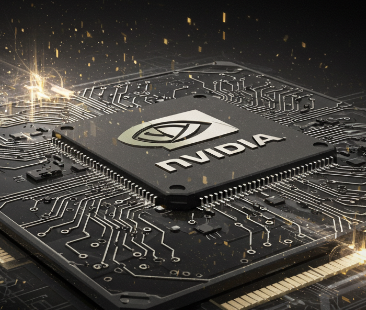
The GeForce RTX 5090 GPU features 92 billion transistors, providing over 3,352 trillion AI operations per second of computing power, representing a generational leap in computational capability that extends NVIDIA’s technological leadership. The Blackwell architecture introduces fundamental improvements in AI processing efficiency while maintaining compatibility with existing software ecosystems, ensuring that performance improvements translate directly into customer value without requiring application rewrites.
NVIDIA’s GeForce RTX 5090 and 5080 GPUs offer up to 8x faster frame rates with NVIDIA DLSS 4 technology, demonstrating how the company continues to push the boundaries of what’s possible in real-time AI inference applications. These improvements have implications that extend far beyond gaming, as similar acceleration techniques apply to professional visualization, content creation, and AI application development.
With 32GB of GDDR7 running at 1.79TB/s and impressive compute capabilities, the RTX 5090 represents theoretically the best consumer GPU for AI workloads available, positioning NVIDIA to capture the emerging market for personal AI computing. As artificial intelligence capabilities migrate from cloud-based services to local processing, the demand for high-performance consumer hardware creates an additional growth vector that leverages NVIDIA’s technological advantages.
Market Expansion and Competitive Position
The enterprise adoption of artificial intelligence represents NVIDIA’s largest and most sustainable growth opportunity. Companies across industries are investing hundreds of billions of dollars in AI infrastructure, driven by the competitive necessity of incorporating AI capabilities into their products and operations. NVIDIA’s position as the primary enabler of this transformation ensures the company captures a significant portion of this investment wave.
Unlike cyclical technology trends, the integration of artificial intelligence into business processes represents a fundamental operational transformation that requires continuous infrastructure investment and upgrade cycles. This dynamic creates a multi-year growth trajectory that supports sustained revenue expansion and margin improvement.
NVIDIA’s expansion into autonomous vehicles and robotics represents a significant long-term growth opportunity that leverages the company’s AI processing expertise while addressing massive addressable markets. The convergence of artificial intelligence, computer vision, and robotics creates applications across manufacturing, logistics, healthcare, and service industries, positioning NVIDIA to capture significant value from the robotics automation trend.
Risk Assessment and Investment Outlook
NVIDIA’s revenue concentration among large customers, particularly cloud service providers and enterprise customers, creates potential volatility risks. However, the company’s expansion into consumer markets, automotive applications, and emerging technologies creates revenue diversification that reduces dependence on any single customer category. The mission-critical nature of AI infrastructure for major customers creates switching costs and demand stability that provides protection against short-term spending reductions.
The rapid pace of change in artificial intelligence hardware creates ongoing risks that new technologies could displace NVIDIA’s current platforms. The company’s comprehensive ecosystem strategy creates multiple layers of competitive protection that extend beyond hardware performance to include software tools, developer relationships, and application optimization, making it difficult for competitors to gain market share even with superior hardware performance.
Government restrictions on AI technology exports and potential antitrust scrutiny represent significant risks given NVIDIA’s market dominance. The company addresses regulatory risk through compliance with evolving regulations while maintaining technological leadership within legal constraints, and diversification of manufacturing capabilities reduces dependence on any single geographic region.
Valuation and Price Target Analysis
NVIDIA’s current valuation reflects the market’s recognition of the company’s dominant position in artificial intelligence infrastructure while potentially undervaluing the long-term growth trajectory and market expansion opportunities. The company’s trading multiples, while elevated compared to traditional technology companies, appear reasonable when considered in the context of sustained high growth rates, exceptional profitability, and dominant market position in one of the most significant technological transformations in history.
A 12-18 month price target of $210+ per share reflects the convergence of multiple growth catalysts including continued data center expansion, consumer AI adoption, autonomous vehicle deployment, and new market segment development. Key catalysts supporting this target include quarterly earnings demonstrating continued growth momentum, new product launches extending technological leadership, major customer wins validating market position, and expansion into new application areas increasing addressable market size.
Investment Recommendation
NVIDIA represents the premier investment opportunity for investors seeking exposure to the artificial intelligence revolution through an established technology leader with demonstrated execution capability and sustainable competitive advantages. The company’s dominant market position, exceptional financial performance, and comprehensive platform strategy create multiple pathways to continued outperformance as AI adoption accelerates across global markets.
The combination of current financial strength and long-term growth potential provides both downside protection through proven business fundamentals and upside participation in one of the largest technological transformations in modern history. NVIDIA’s position as the foundational enabler of the artificial intelligence revolution creates an investment opportunity that combines immediate financial strength with long-term secular growth potential.
The convergence of data center AI acceleration, consumer AI adoption, autonomous systems deployment, and emerging application development creates a multi-year growth trajectory that extends well beyond traditional technology cycles. NVIDIA’s ability to capture value across these diverse applications while maintaining technological leadership positions the company as the premier investment vehicle for artificial intelligence exposure through 2026 and beyond.
Disclaimer: This analysis is for informational purposes only and should not be considered personalized investment advice. Past performance does not guarantee future results. Please consult with a qualified financial advisor before making investment decisions.
Last Updated: September 2025
Next Review: December 2025